
The patented RAPCO2 process
First step
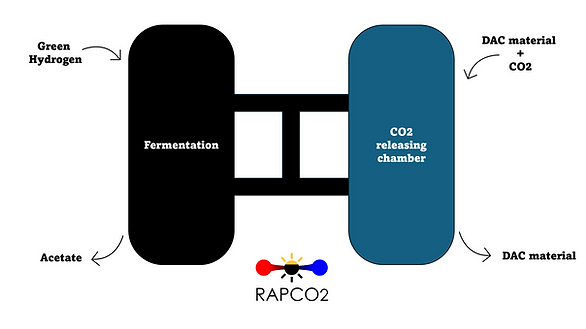
The first step of our process is also our main strength. The material that has captured and become enriched with CO₂ enters the CO₂ release compartment of the bioreactor, where, driven by bacterial consumption and the simultaneous biological pH swing, it releases the CO₂. This step regenerates the capture material simply by equilibrating it with the fermenter conditions — namely 40 °C, atmospheric pressure, and pH = 10 — without heating it to high temperatures or subjecting it to electrochemical pH swings. This approach eliminates both material degradation issues and the most significant energy cost of DAC, namely the regeneration of the capture material.

Second step
Once released, the CO₂ mixes with the gas phase of the RAPCO2 bioreactor and is simultaneously transferred into the fermentation broth, where it is converted into dissolved carbonates. These are then utilized by bacteria to produce acetate. The process is driven by the natural ability of certain microorganisms to reduce dissolved carbonates using hydrogen, which is supplied via an integrated electrolysis stack that delivers hydrogen directly to the biological reactor, without the need for gas storage or purification. This configuration enables the provision of reducing power at competitive costs and allows the use of renewable energy when available, effectively converting it into acetate. This safe and non-volatile chemical compound progressively accumulates in the fermentation broth, reaching concentrations above 10% by weight thanks to an innovative bioreactor design.
The fermentation broth is withdrawn from the reactor and, using waste energy from the process and natural evaporation, is concentrated until acetate crystals are formed.
Third Step
The hydrated acetate crystals are brought to 340 °C in a specialized molten-salt pyrolysis reactor, leading to complete dehydration and the formation of acetone and sodium carbonate. The carbonate and water are immediately recycled back into the biological reactor, while the acetone is hydrogenated in-line using a small fraction of the renewable hydrogen generated by the stack.
This approach enables the regeneration of the alkalinity required for the biological reactor, while simultaneously promoting the production of isopropyl alcohol. This chemical compound is the final product of the RAPCO2 process and can be safely condensed and stored.

The entire process is implemented using standard industrial components and cost-competitive equipment
The RAPCO₂ process is based on the intelligent and innovative combination of natural microbial consortia and spontaneous chemical reactions. The absence of sterility requirements, the use of non-critical materials, and standard industrial components enable the construction of an inherently safe plant with low capital costs and no need for expert-level supervision.
For the first time, RAPCO₂ makes it possible to convert atmospheric CO₂ and renewable energy into useful products in virtually any context.